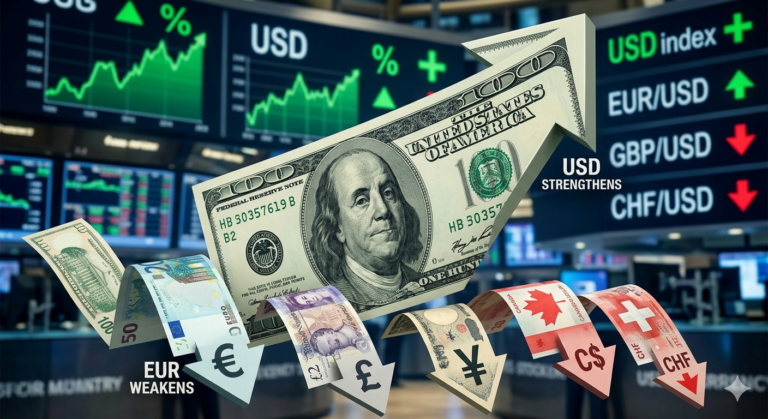
In times of global uncertainty—especially during war and oil disruptions—many expect financial markets to become unstable. However, the opposite is happening with the US dollar. Despite rising tensions in the Middle East and volatility in oil markets, the dollar is strengthening. This may seem surprising, but there are clear economic reasons behind it.
1. The US Dollar as a safe haven
The biggest reason for the dollar’s strength is its role as a safe-haven currency.
When crises occur—such as conflict in the Middle East—global investors move their money into safer assets. The US dollar, backed by the world’s largest economy and strong financial system, is considered one of the safest places to store value.
Investors sell riskier assets (stocks, emerging market currencies) They buy US dollars and US Treasury bonds This increased demand pushes the dollar higher
2. Strong Confidence in Federal Reserve
Another key factor is trust in the US central bank.
The Federal Reserve has maintained relatively high interest rates compared to many other countries. Higher interest rates attract foreign investors because they can earn better returns on US assets.
Result
More foreign money flows into the US Demand for USD increases Dollar strengthens further
3. Oil is Priced in US Dollars
Oil plays a major role in global finance—and it is almost always traded in US dollars.
During a Middle East crisis:
Oil prices rise due to supply fears Countries need more USD to buy oil Demand for USD increases globally
Even countries not directly involved in the conflict still need dollars to secure energy supplies.
4. Weakness of other Currencies
The dollar doesn’t just rise because it’s strong—it also rises because other currencies are weak.
Europe faces economic slowdown and energy risks Japan maintains very low interest rates Emerging markets struggle with capital outflows
When other currencies weaken, the US dollar naturally looks stronger by comparison.
5. Global financial system still depends on USD
Despite discussions about “de-dollarization,” the US dollar remains dominant:
Most global trade is settled in USD Central banks hold large USD reserves International debt is often denominated in dollars
Institutions like the International Monetary Fund continue to show that the dollar dominates global reserves.
In times of crisis, this dominance becomes even stronger—not weaker.
6. Capital Flight from Risky Regions
War and instability in the Middle East trigger capital flight:
Investors pull money out of affected regions Funds move into stable economies like the US This increases demand for USD
This effect amplifies during prolonged conflicts or oil supply disruptions.
Final Analysis
The strength of the US dollar during war and oil crises is not accidental—it is structural.
Key reasons:
Safe-haven demand during global uncertainty Higher US interest rates Oil trade dependence on USD Weakness of other major currencies Global reliance on the dollar system
Conclusion
While war and oil crises create instability worldwide, they often strengthen the US dollar instead of weakening it. This reflects the unique position of the United States in the global financial system.
However, this strength may not be permanent. If global conditions stabilize or US economic policies change, the dollar could weaken again in the future.