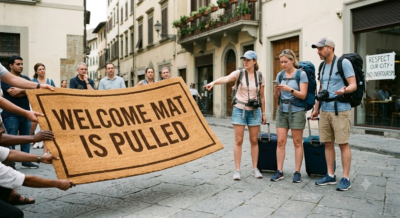
For decades, the American passport was a symbol of unbridled global mobility. Armed with a sense of adventure, a pocketful of dollars, and the assumption that a friendly smile and English would open any door, U.S. travelers fanned out across the globe.
Today, however, the narrative is shifting. From the cobblestone streets of Western Europe to the delicate ecosystems of Pacific islands and the historic hubs of Asia, a growing sentiment is taking root: local populations are becoming increasingly exhausted by American tourists.
While few nations have outright banned U.S. citizens from visiting, a mixture of geopolitical friction, economic pressures, cultural clashes, and the boiling crisis of overtourism has left many destinations rolling out a much cooler reception.
1. The Overtourism Backlash: Loved to Death
The most prominent friction point isn’t necessarily personal animosity toward Americans—it is sheer math. Post-pandemic travel booms have flooded historical cities and fragile natural landscapes with millions of visitors, and American travelers make up a massive percentage of long-haul tourists.
- Western Europe (Italy, Spain, France): In hotspots like Venice, Florence, Barcelona, and Paris, locals are pushing back against housing crises driven by short-term rentals and the transformation of living neighborhoods into open-air theme parks. American tourists—often stereotyped as demanding, loud, and expecting local service staff to cater entirely to English speakers—frequently bear the brunt of local exasperation.
- Iceland and New Zealand: Delicate ecosystems are suffering under the weight of heavy foot traffic. In Iceland, tourists routinely ignore barriers to snap photos, while New Zealand’s adventure hubs face strain from large numbers of transient visitors who sometimes leave a heavy environmental footprint.
2. Cultural Clashes and the “Ugly American” Stereotype
Perception matters, and the persistent stereotype of the loud, culturally oblivious American continues to linger abroad.
Surveys tracking global attitudes toward travelers often highlight a common refrain: Americans are frequently perceived as lacking local cultural awareness. Whether it is failing to learn basic localized greetings (such as a simple Bonjour in France), disrupting the quiet sanctity of temples in Japan, or ignoring traditional rest periods like the Spanish siesta, these micro-behaviors accumulate.
When tourists treat foreign nations like an extension of their domestic entertainment bubble rather than living, breathing communities, resentment naturally follows.
3. Geopolitical Tensions and Strained Relations
Beyond cultural misunderstandings, hard political realities create environments where American tourists may feel a distinct lack of warmth—or face outright bureaucratic hostility.
- Nations with Active Friction: Countries experiencing deep diplomatic rifts with Washington—such as Russia, Venezuela, or parts of the Middle East—cultivate environments where anti-American sentiment can run high, or where bureaucratic surveillance makes travel deeply uncomfortable.
- Strict Red Tape: Countries like Iran, Turkmenistan, and previously Russia have implemented severe visa restrictions, mandatory government guides, or complex vetting processes that effectively signal U.S. citizens are far from prioritized or easily welcomed.
The Shift Toward “Mindful Travel”
Does this mean Americans should stay home? Not at all. Tourism remains a vital economic engine for millions of small businesses, guides, and hospitality workers worldwide.
However, the era of the passive, entitled tourist is rapidly closing. Destinations are no longer willing to trade their cultural integrity, quiet, and environmental health purely for foreign dollars. For U.S. travelers looking to navigate this shifting landscape, the key to a warm welcome has never been more straightforward: lower the volume, learn the local customs, respect the boundaries of the host community, and travel with humility.